Showing posts with label Water. Show all posts

Thursday, February 3, 2011

Creating hanging water for more sustainability

One might think that having a few pot plants at home may not have a very big effect in terms of sustainability. In this blog post I want to illustrate several things though. One is that we can have plants that manage water more efficiently, and hence grow better and more vigorously, that not only benefit the home environment, but that this idea is applicable to a much wider scale, and can be applied to whole cities and agriculture.

One would first have to explain what is "hanging water". Hanging water is literally water that hangs, one might think it could be perched water, however this is another concept, and is defined in the following way:
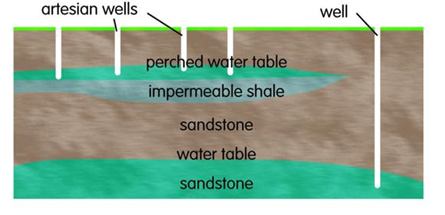
A perched water table (or perched aquifer) is an aquifer that occurs above the regional water table, in the vadose zone. We can illustrate it as in the photo that we see below:

source: http://img.sparknotes.com/figures/3/31ebea601a7d05e9ec8d0854cec9b406/earthscience_f21.jpg
The above situation then is water that sits on top of an impermeable surface. It is not really hanging.

Hanging water, as we had said, is water that hangs.
What does a hanging drop of water on a finger have to do with sustainability and good water management? This is the amazing thing of how small things can have enormous effects, I first understood a bit about this when my electronics professor who was an electronic engineer, like I would later become, loved to explain to his student that the difference between an Electrical Engineer and an Electronic Engineer was that the first can do big things with big voltages, and the the second does it with small voltages, hence having more merit. I cannot help but feel the same sort of thing and draw a simile with water, alas there is no real distinction as yet, to make a differentiation in water related careers. My experience with water engineers and professionals from around the world, shows that there is a tremendous amount of ground to be covered. Water engineering even till today focuses most of there effort on hydraulics managing volumes of water in quantities, paying very little attention to quality of water, and those that look at quality do so often with total disregard of undesired consequences.

Going back to hanging water then...
The fact that the water hangs in this way has tremendous implications in many applications. If the water had not found the end of my finger it would have continued it's journey downwards following the pull of gravity. What we are doing in essence is "conserving water".  If we are able to create similar "fingers" that hang water across vast areas we would be conserving huge amounts of water. How much? Experience has shown up to 76 litres per square metre. Quite a bit and just with a the same effect that a finger has with a drop of water.

The water hangs because it adheres to the surface it is on. This adhesion, that is much related to capillary action, poses a force that exceeds the pull of gravity. This adhesive power can be used to benefit.

The idea then is being able to hang water close to plan root structures, making it immediately available to vegetation. That the water should hangs arrests the "loss" of water travelling further down the soil profile. Water is conserved in the soil profile while it hangs in a state of "ideal" saturation, it is ideal because in the moment it becomes over saturated the hanging water drop will fall, plants will consume as much water as they need.

This hanging water can be created for a practical purpose in a "micro" implementation as is pot plant. One may say that what I am going to show is just another what have become to be called a "self watering pot", to an extent it is, though I think that the name is foolish to begin with. My design however does have a twist.

This is a typical pot for a plant. I am going to convert how we can apply hanging water.

In the base of the pot there are 2 small holes, which I insert with geotextile strips. This is to provide capillary action and a physical connection to the pot tray and the inside of the pot.
Here we can see the geotextile strip on the outside.

The base of the pot is lined with geotextile, this is to provide a layer of capillary action.

One cuts a piece of Atlantis Drainage Cell, to the size of the base of the pot.
The Drainage Cell gets a strip of geotextile for further capillary action.
The piece of Drainage Cell is placed on the bottom of the pot.
The piece of Drainage Cell is covered with another layer of geotextile, this serves the purpose of creating a separation media so that the soil we will add does not fill the drainage cell, and is what provides our much mentioned hanging water.
We fill around the plant with compost, here I very proudly show my own compost bin, where we can clearly see how the vegetable waste gets turned into very nutritive soil. Of course composting is something very sustainable, apart from being economical as one saves money on having to buy potting mix.
Here we can our pot plant ready with and Golden Cane or Areca Palm (Dypsis lutescens).
Here we can see 2 other pots that I had prepared and how the system works. One can observe that instead of thin strip connecting to the tray, I have laid a layer or square piece of geotextile. The plants can "never" be over watered, because as soon as the soil over saturates the excess water falls and is contained in the tray. In the measure that the plant needs water, through the capillary action infrastructure that we have provided, it access "sucks" that water. We have done in essence, for practical effects, is extend the root structure of the plant. On the left is pot where we see that the tray is dry and could with some water. This does not necessarily mean that the soil is dry as it could very well be at its point of saturation, what it does indicate is additional water capacity in the pot.

The ability to control soil humidity to "ideal" levels is something that some agricultural methods use extremely sophisticated sensor technology that then activates watering circuits and so on, here we have in a pot, created a much more effective, simple and sustainable method and technology that should never fail, that has no real moving parts, except for the water, that requires no power.

This sort of technology can be applied on mass scales and has already been done so in examples of roof garden technology. However this technology  that been used almost exclusively for roof gardens has to advance to another level, and that should be into agriculture.

I believe the way we do agriculture has to make its next step, what I would call Natural Sustainable Agriculture. Though one can argue that hydroponics is a step forward in agriculture, it can be said that it makes more efficient use of water, however I personally find few thing s more unsavoury that hydroponically grown tomatoes, that have a texture like plastic, not much colour, and less flavour. There is nothing like a succulent field grown tomato ripened on the stalk bursting with flavour, juice and texture.

To cover a last point and respond a question often asked, and respond to some raised eyebrows when we say that hanging water can mean providing storage of water of 76 litres per square metre. How can this be measured? Very simply, we get box with a base one square metre, on the bottom we put drainage cell, cover it with geotextile, and fill the box with soil media. Obviously the type of soil media will affect the result, but is to provide a typical soil profile that can be sand and organics. The depth could be any depth, but as we already have a reference it can be done with lets say 1 metre depth. We start filling the box with water and measuring the amount of water we are adding. The water should not drop down from the geotextile until it reaches a level of saturation, where the "weight" of the water exceeds that adhesive capacity of the water on the soil media, and capillary action of the same, and eventually a drop will fall. That falling drop will give the water bearing capacity that this concept, or rather implementation of creating hanging water has.

Tuesday, January 25, 2011

Indigenous Biomass in underground water tanks.

What is indigenous biomass? Biomass has a few acceptions, one of the most simple ones is : "mass of living biological organisms", it also has a connotation from a renewable fuel source perspective. In any case our first definition encompasses this too. The indigenous component of the term comes from the definition: "Originating and living or occurring naturally in an area or environment." So basically we can say that it is life forms that occur naturally, and in the case of this topic, in underground water tanks.

Having defined the above we can discuss about how we can manage Indigenous Biomass to an advantage, as it can have very good or very bad effects on the quality of water.

Why is this question relevant?
It is a frequent question I get related to what happens in underground water tanks being related to appearance of biological matter in the tanks and how it affects the water quality. In addition to this we often get questions associated to the maintenance of the system, in relation to the previous phenomenon. I stress that if a system is properly and correctly designed, it should not require maintenance, this is the first point of a correct Environmental Sustainable Design, if it requires maintenance, it is not sustainable.

Beyond the specific design of a particular project, one obviously needs good components to achieve sustainable outcomes. So once again, we have to look at integral design considerations. In addition to this we have to look at the quality of the water that is going into the system, because no matter how fantastic is our design and the quality of the components, in terms of their functions if we put in water that is beyond the scope of the design we will not have the desired outcomes.

It is often heard and said, that where there is water there will be life. In fact it is not a coincidence that the first thing scientists look for in space exploration, searching for habitable environments, is the presence of water so that it may be able to sustain life.

We can start by saying that water, unless it is contained in sterile conditions, will invariably "generate" biomass. Keeping large amounts of water in sterile conditions is very difficult and not very cost effective. What happens then is a situation that we see very often, water, unless it managed correctly, will become stagnant.

Water as soon as precipitates from the sky, where it is normally free from biological matter, and touches the ground it immediately becomes subject to conditions that can be "good" or "bad" for it's quality. The words good or bad are purposefully subjective. 

We must first define what is good water quality, this is normally done, among other parameters by presence of Fecal Coliforms (FC), Coliforms, E Coli, pH (acidity), Heterotrophic Plate Count, Turbidity, Heavy Metals, BOD, COD, TN, TP, etc...

To be simple in our explanation we can say that water can be kept in two sorts of environments, one that is entropic or one that is negentropic. As entropy is associated with degradation, in this case of water, we should be looking to create a negentropic environment. I have addressed the subject of Negentropy from an ESD perspective in a previous blog post.

The important thing is that if the water enters a negentropic state or environments it becomes subject to a compounding effect that creates a vicious cycle if you wish.

There are things that are not "too" complicated and achieve several desired outcomes can be things like the following:
Keep water underground

Effects: Keeps water temperature low
Keeping water underground normally keeps water cool, unless it close to geothermal active area.


source: http://iopscience.iop.org/1748-9326/2/4/044001/fulltext
In the above graph we see how as we get to a depth of 6 meters underground, temperatures have a tendency towards about 9 degrees C. The largest change happens between 0 and 3 metres depth which is where it is most practical and cost effective to install underground tanks. This is will also important from a physical aspect that I will explain in more detail in the section I explain about capillarity.

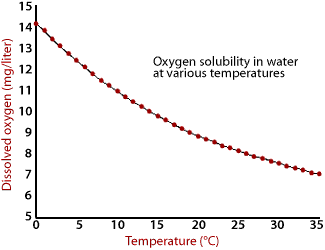
From a chemical point of view the importance of temperature is relevant as the cooler the water, the higher the Dissolved Oxygen (DO) capacity that it has.


source: http://www.cotf.edu/ete/modules/waterq3/WQassess3f.html


The oxygen content is important because, the lower the DO, the higher the probability that anaerobic activity should occur, though paradoxically one could say that this an inevitable consequence anaerobic activity or digestion occurs once the dissolved oxygen has been consumed, which is a consequence of aerobic activity rather than anaerobic, however it can also be observed that aerobic digestion also reduces Biological Oxygen Demand (BOD),  which is something positive.

Aerobic digestion, is often associated to composting, which is a process that creates practically immediately usable by product without any undesirable by products, which is not the same situation with anaerobic digestion which creates sludge and methane. Recent and more modern process have made plants that use this process more efficiently, the methane, which is a green house gas, can be used for heating either to dry sludge or for power generation or even both, but the burning of the methane, produces carbon dioxide too. The management of sludge is also quite a complex process and there is an entire industry dedicated to it, in best cases when process it can be used as fertilizer, or worst case burned, creating a lot of pollution or buried and lost. Aerobic digestion in water treatment also serves to reduce BOD as well as pathogens and other desirable outcomes.

Why is all of this relevant to underground tanks? Very simply because all of these process can occur in underground tanks.

The very temperature also has an effect from a biological perspective on what types living matter can exist in water, in addition to this, the cooler the water the longer that water can remain in better conditions as biological metabolisms are directly affected by temperature, as such the colder the temperature the slower the reproductive cycle.

Effects: Keeps water dark
The effect of keeping water dark is very important, apart from the presence of light being associated with heat, in this case the darkness is important to protect the water from plants that perform photosynthesis. Though photosynthesis can normally considered something positive as it is an oxygen producing process, however this also implies that the plant metabolic process that also requires some measure of oxygen as the plant apart from to photosynthesising also performs cellular respiration, which consumes oxygen, instead of producing it. Aside from this a very common form of algae that may become present in water exposed to light is what is generally named Blue Green Algae or Cyanobacteria, this type of algae poses two main situations that are of interest, one is that it produces toxins which are know as Cyantoxins, which undoubtedly poison water. The other interesting aspects within their robustness is that they are also able to exist not only in aerobic conditions, but also anaerobic conditions, which then presents the problems we had mentioned in the previous point.

source: aims.gov.au
Source: gallery.usgs.gov
 The best thing then is to avoid light.

Provide high surface area to volume ratio
Providing a high surface area to volume ratio does mainly two interesting things.
Effects: More surface area for beneficial biomass
The more surface area one provides the more ability there is to form biofilm. Biofilm is a form of biomass. Biofilm necessarily exists attaching it self to surfaces, hence the more surface area we provide in a determined volume the better it is. If we have the presence of "good" biofilm.


Above is a photo of excavated modular tanks, that where taken out of the ground after 6 years. The tanks were excavated because within the scheme of the Australian Economic Stimulus Plan for schools, this school received funding to construct an additional building and as such relocated the position of the tanks. The case study for the original installation that was done in 2004 can be seen here. What is impressive about these tanks is that having been removed from the ground that they are in impeccable conditions.

What is important then is to explain why the presence of biofilm is good and beneficial for an underground tank system.
 
I have listed below 2 interesting and relevant points from the wikipedia article on biofilm:

  • Biofilms can also be harnessed for constructive purposes. For example, many sewage treatment plants include a treatment stage in which waste water passes over biofilms grown on filters, which extract and digest organic compounds. In such biofilms, bacteria are mainly responsible for removal of organic matter (BOD), while protozoa and rotifers are mainly responsible for removal of suspended solids (SS), including pathogens and other microorganisms. Slow sand filters rely on biofilm development in the same way to filter surface water from lake, spring or river sources for drinking purposes. What we regard as clean water is a waste material to these microcellular organisms since they are unable to extract any further nutrition from the purified water.
  • Biofilms can help eliminate petroleum oil from contaminated oceans or marine systems. The oil is eliminated by the hydrocarbon-degrading activities of microbial communities, in particular by a remarkable recently-discovered group of specialists, the so-called hydrocarbonoclastic bacteria (HCB).
Effect: Increased capillary action
Capillary action is present for several reasons in correctly designed underground tanks, because of several components that contribute to it.
Sand: Sand has capillary action that occurs because of the granularity of sand. A tank that is correctly designed should be surrounded by an "envelope" of sand. The sand in this case also provides a situation that has a filtration effect that is not only mechanical and physical, but also biochemical as stated from the effect the biofilm has on the sand.
Geotextile: Geotextile as a fabric has capillary action. Below is a photo that shows this effect. A geotextile is a fabric that is made of plastic polymers, that for practical effects, does not biodegrade with time, especially if it is being kept underground. Geotextile should cover the modular tanks so that the sand surrounding the tanks does not enter the tank. In this case it not only serves as the purpose to provide capillary action but also as a separation and filter media.
source: http://www.sciencebuddies.org/science-fair-projects/project_ideas/PlantBio_p033.shtml
Tank components: Some modular tanks, have flat sides, these flat sides when placed together also creates capillary action. The closer the plates are together, the more pronounced this effect is.
source: http://webapps.lsa.umich.edu/physics/demolab/controls/imagedemobg.aspx?picid=1102

Capillary action has several effects the main one is that it moves water. As capillary action moves the water upwards, against the force of gravity, it eventually reaches a stage where it can not go up any more, at the same time it has more water molecules below it that are pushing up, as they are subject to the same forces of capillarity, however the difference with the situation of the tubes shown in the above photo, is that water in the sand, in the geotextile or between the modules, can "fall off" the tube, or be subject to a situation where as the cooler water from the bottom of the tank which is more dense, enters an area where the water is warmer and hence less dense, this cooler denser water will naturally descend again, until it gets to it's level of homeostasis, and again be subject to the effect of capillary action. This constant movement of water, by definition eliminates the possibility of the water stagnating. In association with this, as water would reach the water surface, it will also be subject to air and as such become aerated, once more increasing the Dissolved Oxygen level.

Comparisons with different types of underground tanks

Having said the above we can say we have found a situation where were create practically ideal conditions for the conservation or storing of water. So one could say that as long as one puts water underground then it should be acceptable. Not so much so, traditionally one of the most common types of underground water storage tanks have been cisterns made of concrete, these can be strong, but have the observation that the have an extremely low surface area to volume ratio, as such, unless external power consuming agitation, aeration devices or chemicals are used the water will go stagnant. The same is true of similar plastic or fibreglass cisterns. Recently there have also been a number systems that use "half pipes" providing void volumes, these have a larger footprint as they cannot be stacked, and are infilled between the half pipe rows with crushed rock or similar, this we could say is better that a traditional concrete cistern, as they are comparatively providing a slightly higher surface area to volume ratio.

As such having made the above analysis, we can see that to have indigenous biomass that is aerobic and beneficial for the water quality we also have to provide a good environment for it to exist. If this is done it can even be said that the quality of water while it remains in such a type of environment will improve with time.
Friday, December 31, 2010

Water Energy Nexus

This is a post that I am writing in relation to a discussion on a LinkedIn group (Water Professionals) that has become quite interesting and is titled: 'What is the "Water Energy Nexus"'.


The discussion has evolved a bit and has arrived to a stage where maintaining focus on the central discussion sometimes becomes a bit complicated. However there are several things that must be said.


I plan here to attend each one of the points that I find are pertinent for me to discuss, as well as introducing some other relevant points, that have to do with the topic.

Vested Interests
The main challenge of this discussion is the presence of vested interests that are particular to certain industry or market segments, that obviously have an interest in establishing themes or topics to their benefit.

I will start by addressing a comment which is very simple.

To be or not to be, that is the question...
On my first comment in the discussion I stated that the Water Energy Nexus "should not exist", I maintain this. That it is does exist, surely it does, will it exist forever, it is very likely and probable, however this does not justify or approve it's existence.

Commenting to whether it "should" exist or not, is totally and absolutely pertinent, and does not distract whatsoever from the central point of the discussion, similarly as to saying: "should Polio or Small Pox exist?" Surely they do,  they have, they where a huge problem and scourge for humanity when they were prolific, today fortunately we can say they are pretty much under control, if not practically eradicated. I go further and postulate that we should treat the Water Energy Nexus probably in a similar manner.

There is a situation that undoubtedly is of interest to parties who stand to benefit from a Energy Water Nexus. In the measure there is more energy required, or needed to be sold, or bought, for that matter, there will be people interested in driving this agenda. Of course!!! The promotion of things much more unethical is not unheard of, lets take the tobacco industry for example, another example, it seems sad to say, but some people were even opposed to abolition, where people have an agenda they will push it. Not even a few decades ago have people were still defending segregation, not only in the US, but in Australia too, what used to be North and South Rhodesia (Zambia and Zimbabwe),  naming a few, even in South Africa the most recent example... what has this got to do with the Water Energy Nexus though? People will defend things that in hind sight may seem a bit odd, to say the least...

Energy
Then we must come and analyse energy then. What an interesting topic, especially now in current times. What is energy? The evolution of how energy has been managed over the years is amazing. From basic human power, to "transportable" and stronger animal power, to what was able to initially power the industrial revolution, a combustible solid, coal, that later gave way to oil and it's derivatives. The parties that controlled sources of energy, also controlled "power" in many more ways than one.

Our current generation has seen the appearance of renewable energy. What a fantastic development! Of many types of renewable energy such as wind, solar, geothermal... who knows how many more will become prevalent.

What is more interesting is the shift that Oil companies have done to become "Energy" companies, how amazing to see how companies like Chevron, now portray themselves as an environmental company! (http://www.chevron.com/globalissues/environment/) It never ceases to shock me when I see their TV commercials, not only when in the US, but also in Australia, also in India, in the Middle East, in South America, where the images are the same and all that changes is the accent of the narrator.

If I were an oil company I would do the same thing, it is very clever. The railway companies were never so smart, after the days of the railway barons. They failed to see that the business was a transport business, not the rail business.

In the same way businesses obviously try and make a business "environment" favourable for there business. A very good example is how General Motors bought and destroyed the California Transit System (http://www.trainweb.org/mts/ctc/ctc06.html), a bit more research will reveal a lot more. It may be "coincidence" that in the discussion we are talking about the same state? Some people say there is no coincidence, only causality. The interesting thing though was that it was not just GM and Ford, to benefit from the absence of a viable mass transit system, also to benefit from this was the Standard Oil Company. Who was to provide the fuel for the cars that would replace the rail system? Who was to supply the oil for lubrication in the engines and chassis of the cars? Who was to supply the rubber for the tyres? Who was to supply the asphalt for the constructions of the same very roads that the cars would roll on? Who was to supply the many synthetic plastic polymer based components that cars would come to be made of?

The appearance of renewable energy sources as viable alternatives is not something that the now "energy" companies love so much in that they are environmental solutions, as much as they will be able to sell a "product" that will never run out, it is literally like a hen who lays golden eggs, though even more so as this "hen" practically does not need to be fed, beyond performing minimum maintenance on the systems.

However this is not also an overnight thing. Renewable energy technologies have a lot more to be developed, they still has long way to go. In the meanwhile though sources of energy have to be assured and made safe for those who want them or need them.


Related to this I invite you to read The Grand Chessboard by Zbigniew Brzezinski.
This book is amazing, Mr. Brezezinski is not a common man, as his CV will tell, he has been the advisor to several presidents of the US. Here are the plans of how the above was to be achieved. It is very notable that just last week world news headlines stated that Iraqi oil production had reached a 20 year high... what a coincidence... (http://www.google.com/hostednews/afp/article/ALeqM5gPT7AbUUj-WkyvUuyi99MrcJ85cw?docId=CNG.ef38a7e4c7ef34703610b728e354c915.f41)

Yes whichever way we look at it, there are people interested in conserving this Water Energy Nexus. Whether it be renewable energy or not is beside the point. If it is renewable then better, now if we are able to provide water with no requirement of energy that is the optimum situation. That is what I would advocate.

Superseding outdated infrastracture
What of the current infrastructure and the current existing system. What can I say?? That Southern California should not be abandoned? I totally agree, it should not. Could it be made self sustaining though? I would say probably, and even more so, without much expense. That also seems a bit amazing to state that one should not abandon something, from a country that replaced the Pony Express with copper wires and is now doing the same with fibre optics. To my knowledge the Pony Express ran for the last time in October 1861, it has not been missed, beyond a bit of nostalgia. The Pony Express was abandoned only for the benefit of the economy, likewise will happen with copper. Where a cost effective solution is to be found it will likely prosper, though it will find obstacles if there are parties who are not interested in someone else's prosperity but rather their own. Maybe it is better to use the word superseded, instead of abandoned, it has a more positive connotation.  Who knows what technology will replace fibre optics?

So how can this be done? Water without the Energy Nexus. What experience exists?

Experience related to different parts of the water cycle
At every stage of the water cycle things can be done in a sustainable way. However one of the greatest challenges is to have the correct, or rather a better or more adequate,  model of the water cycle.

A relevant document that illustrates this situation is a study done by the government of California:
http://www.energy.ca.gov/2005publications/CEC-700-2005-011/CEC-700-2005-011-SF.PDF

To address a discussion of mentioning initially how the water cycle should be modelled for a sustainable outcome goes a bit more beyond a simple discussion in a forum or a blog post. How from this, each stage of can be managed in more sustainable manner, also goes beyond this scope. However it can be said simply that the technology exists and has been under development for practically more than 30 years, though it goes beyond just technology and involves mainly concepts and philosophy.

The best way to demonstrate experience is to show case studies: http://www.atlantiscorp.com.au/projects

It can be noticed that not only can we witness considerable amounts of experience in the different stages of the water cycle, there can also be seen experience in amounts of time, but also a significant variety of geography, going from desert climates, to tropics, to temperate regions and practically everything in between. I personally have experience directly in a number of these projects.


So what is the Water Energy Nexus?
As we can see there are several ways of answering this question. One is simply to say: "the amount of energy required for the management of water, including it procurement, processing, supply and distribution and posterior treatment." Another is to say that: it is a way to market energy related applications for water management... and then go on from there...